

The Scale Blueprint: Grow Without Chaos in the Fitness Industry in 2026
#IAmSetForSuccess part 5
#IAmSetForSuccess part 5
Six months in, you’re living the dream. Clients booked. Income steady. Doing what you love every day. Until you do the maths.
40 sessions a week at £40 each sounds like £1,600. Until you subtract tax, insurance, equipment and travel, then suddenly that number doesn’t feel quite so comfortable. And somewhere between your 6am start and your 8pm finish, you realise you’re exhausted before the week is even half over.
Where is the time for admin? For lunch? For your social or family life?
Here’s the thing nobody tells you when you’re starting out: there are only 168 hours in a week. And right now, most of yours are spoken for, either in sessions, or recovering from them. This is trainer’s dilemma. You’ve built yourself a job with a ceiling, not a business with potential. The trainers who break through this aren’t working harder; they’ve just figured out how to multiply their impact without multiplying their hours. And that’s exactly what we’re unpacking here.
Welcome to #IAmSetForSuccess, a five-part blog series designed to take you from newly qualified to confidently running a fitness business that grows on your terms. In Part 1: The Spark, we covered why most fitness careers stall before they start and how to flip the odds. In Part 2: The Identity Shift, we explored how to go from invisible to irresistible as a fitness professional. In Part 3: The Conversion Code, we showed you how to turn interest into income without the hard sell. In Part 4: The Loyalty Loop, we unpacked how retention, referrals and results compound over time. Now in Part 5, we’re bringing it all together: how to scale smart, grow without chaos, and build a fitness business with real long-term potential.

The fastest way to break your income ceiling seems obvious: train more people at once. But most newly qualified trainers resist this. They worry they can’t deliver the same quality. They’re scared clients won’t get results in a group setting. They think group training is somehow “less professional” than 1:1.
Meanwhile, the trainers making actual money have done the maths differently.
One hour of your time. Ten people at £8 each. That’s £80. Same effort as a single £40 session, double the income. And here’s the part nobody tells you: clients often get better results in groups because of the community, accountability, and competitive energy. Boot camps are the entry point. Low individual cost (£5-10 per session) makes it accessible to people who’d never commit to full personal training prices. They get to try you out risk-free. You get immediate cash flow and the chance to prove your value to multiple potential long-term clients simultaneously.
Where does this happen? Public parks are usually free and accessible. Community centres with affordable rental prices. Outdoor spaces. Minimal equipment: cones, resistance bands, bodyweight exercises. The barrier to entry is incredibly low.
The structure is simple: 45-60 minute sessions with a dynamic warm-up, circuit-based main workout with timed intervals, a punishing-but-achievable finisher, and an intentional cool-down. Rotate circuits weekly to add variety, so your clients stay engaged and coming back. Celebrate client progress publicly to build momentum. For many trainers, group sessions become the reliable income base that funds everything else while they build their premium offerings. Small group training sits in the middle. 4-8 people. Higher price point (£15-25 per person). More personalised programming than boot camps but still scalable. You can run strength-focused sessions with partners working through stations, team challenges that build camaraderie, and ability-grouped circuits that let you coach multiple levels simultaneously.
Well-structured sessions where everyone feels challenged, supported, and seen, even though you’re working with multiple people at once.
Here’s what successful trainers know: you don’t grow by waiting for people to find you. You grow by creating momentum.
Challenges work. A 21-day fitness challenge attracts leads quickly, builds trust through daily touchpoints, and creates a natural pathway into your paid programmes. Pick something specific and achievable: “21-Day Core Strength Challenge.” “3-Week Gym Confidence Builder.” The timeframe is short enough that people commit, but long enough to see real change. Daily tasks. Accountability check-ins through a Facebook or WhatsApp group. Progress celebrations. By the end, participants feel connected to you and each other, making the transition to paid services feel obvious rather than pushy.
Not everyone converts immediately. But many will over the following weeks, especially if you’ve delivered genuine value and built real relationships. Collaborations multiply your reach. Partnering with physiotherapists, nutritionists, Pilates studios, local cafes, health food stores, anyone serving your ideal audience, expands your visibility exponentially.
Co-host free wellness events. Offer exclusive discounts to each other’s customers. Run joint social media content. Write guest posts for their platforms. You’re leaning on their credibility and tapping into an audience that already trusts them. Corporate wellness is the hidden opportunity most trainers ignore. Companies have budget. One corporate client can mean training 10–20 people simultaneously with steady monthly income and far less marketing effort than chasing individuals.
The key is framing it around what companies care about: improved productivity, reduced sick days, better employee retention. Not “lunchtime gym classes” but workplace wellness programmes that solve real business problems.
Want proof that it works at scale? Future Fit has case studies from organisations like Total Fitness and GM Active that show exactly how structured fitness and development programmes deliver measurable results for employers. These are the kinds of outcomes you can use to frame your own corporate conversations.

Once your in-person schedule is maxed out, online coaching is how you scale further.
Different time zones. Different countries. No commute. Lower overheads. Higher profit margins. You can work with clients anywhere while they access your expertise on their schedule.
But here’s where most trainers get it wrong: they think online coaching is just sending workout PDFs and hoping for the best. Online coaching only works if you build systems. Structured programmes with clear timelines (6-week, 12-week transformations). Weekly video check-ins. App-based progress tracking. Nutrition guidance. Regular accountability, but within boundaries so you’re not fielding WhatsApp messages at midnight. The trainers succeeding online aren’t just knowledgeable, they’re organised. They’ve built repeatable frameworks that don’t require reinventing everything for each client.
Hybrid models are even smarter. See clients face-to-face once or twice a month for assessments, form checks, and connection. Deliver the rest online. You get the rapport of in-person training with the scalability of remote delivery.
Think about it: instead of 20 weekly 1:1 sessions, you could have 10 in-person clients, 20 online clients, and two group sessions a week. Same income or better, with significantly more flexibility in how you structure your time.
Scaling without falling apart requires one thing most trainers don’t do: tracking what works.
You’re busy. You’re posting on social media daily. You’re training clients back-to-back. But do you know which marketing efforts bring in clients? Which services are most profitable? Where your leads come from?
Track the basics. Monthly metrics in a simple spreadsheet: new leads and their source, social media engagement patterns, client acquisition costs, which packages sell best, retention rates. When you spot patterns, you can double down on what works and stop wasting time on what doesn’t.
Ask your clients directly. Run quick surveys. Do end-of-programme evaluations. “What do you love most? What could be better? What made you choose to work with me?” This isn’t just feedback, it’s free business intelligence that tells you exactly how to improve.
Delegate before you drown. As you grow, admin will kill your momentum. Booking systems, invoicing, social media scheduling, email responses. At some point, hiring help, even a VA for a few hours a week, becomes the smartest money you’ll spend. The trainers who scale successfully think like business owners, not just coaches. They build systems that run without them, freeing up energy for the parts only they can do: coaching, relationships, programme creation, strategic decisions.
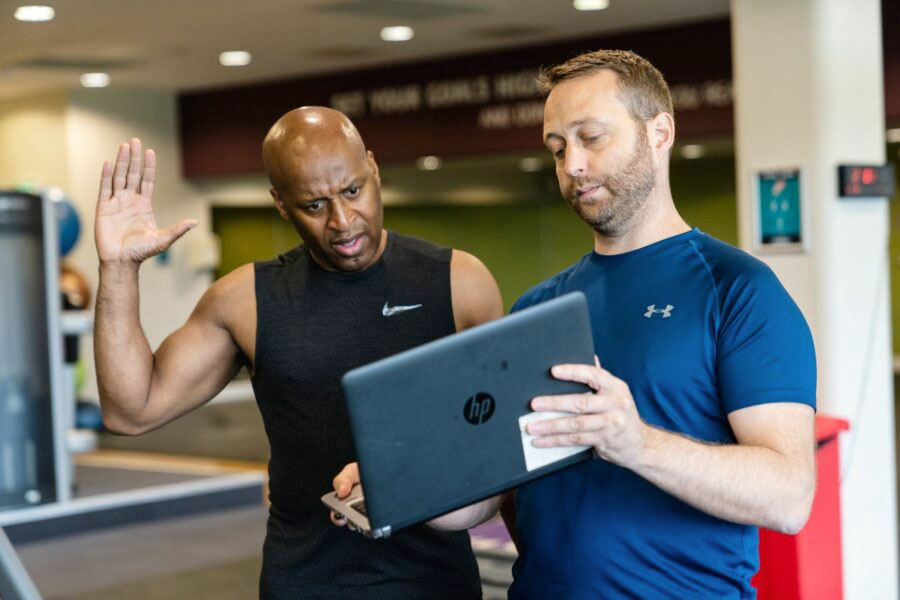
Everything we’ve covered: group training templates, challenge frameworks, partnership proposals, online systems, tracking tools, is in the programme. Not vague advice, but actual templates you copy, scripts you adapt, step-by-step implementation guides you can use tomorrow.
You qualified because you’re good at training people. But growing a sustainable business requires a completely different skill set, and nobody teaches it in your Level 3. That’s the gap Set for Success exists to close. And if you’ve read all five parts of this series, you already know what’s possible. Now it’s time to act on it.
Set for Success is completely free for Future Fit learners on Level 3 and above qualifications. It’s designed to take you from qualified trainer to business owner with the systems, tools, and confidence to scale smart.
Here’s everything the programme includes:
You’ve seen the blueprint from spark to scale. Access the full Set for Success toolkit to put every piece into action: templates, scripts, and guided steps included.
You’ve read all five parts. You know the framework. You understand the system. The only thing left is to build it, and Set for Success gives you everything you need to start today!